Chapter 3
Tomás trembled slightly against him. Marcos pressed his hand more firmly against his brother’s back.
— Tomás eats when I cook. Not always, but when I cook. He eats mac and cheese on Tuesdays and Thursdays, and rice with chicken on Fridays, and French omelette on Saturday mornings with the grated cheese because he says it’s different from sliced cheese and he’s right, it is. He eats when I’m there. That’s not in any file.
A pause.
— When our mother died, Tomás didn’t speak for three weeks. Not to anyone. He started talking again when I sat with him at night with the dinosaur book and read to him about the triceratops and the brachiosaurus. Not because I’m special. But because I’m his. That’s not in any file either.
Marcos breathed.
— I know I can’t be his legal guardian. I know I’m not old enough at sixteen for that. But there’s a foster family Patricia has found who says they can take me too, and I have a job and I would contribute, and what I’m asking this court — what I’m asking you, Your Honor — is not to separate us. Not because I can replace what we lost. But because we are what we have.
The room.
The silence.
Tomás’s hand squeezing harder.
And then Marcos said, in the voice of someone who has prepared this phrase and is also discovering it in the moment of speaking it, of someone who believes it with every part of himself he has built over the last eight months:
— I have no parents. But I can take care of him.
Five — The Room After the Words
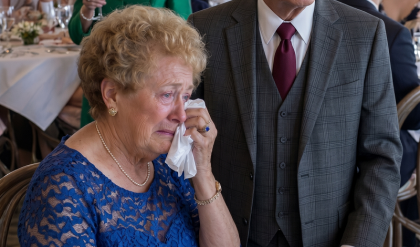
In the second row, the young woman with long hair had her hand over her mouth.
She was not a journalist. She was Sofía Andrade, twenty-six years old, a social work student in her final year of placement, who had come to this hearing as part of her training and found herself doing something she had not done in any previous hearing: crying.
She didn’t try to stop. She was simply there, hand over her mouth, watching a sixteen-year-old boy standing at a podium with his little brother clinging to him, saying the simplest and truest words she had heard in that building.
Judge Varela did not have the marble face.
This was what everyone in the room would remember afterward — not what the judge said, not the resolution, not the legal details of what came next — but the moment when the judge’s face did something. Not much. A long blink. A tightening in the jaw. The kind of adjustment a face makes when it is processing something that exceeds its usual category.
Four thousand three hundred cases.
Four minutes and seventeen seconds.
Then Judge Varela said:
— We’ll take a recess.
Six — The Hallway
In the hallway, Marcos leaned against the wall and held Tomás.
Tomás had stopped crying. He was exhausted with the particular exhaustion of children who have cried completely — not the exhaustion of sleep, but the exhaustion of having emptied something that needed to be emptied.
— How did it go? — Tomás asked.
— I think well.
— Did you do well?
Marcos thought about this.
— I said what was true.
— Is that enough?
— I don’t know, — said Marcos. — Sometimes it’s enough and sometimes it’s not. But it’s what I had.
Tomás nodded against his chest.
Patricia arrived down the hallway with an expression Marcos had learned to read — contained, professional, but with something underneath that wasn’t containment.
— The judge has asked for additional documentation, — she said. — About the employment history, the foster family’s situation, Tomás’s academic records. It’s a good sign.
— How good? — asked Marcos.
Patricia looked at him for a moment.
— Good enough that I’m here instead of having sent my assistant, — she said.
Marcos understood what that meant.
It wasn’t certainty. But it was something.
Sofía Andrade found them in the hallway twenty minutes later.
Marcos didn’t know her. She introduced herself — her name, her studies, that she had been in the room — and then didn’t know exactly what to say, because there were no words that wouldn’t be insufficient, and so she simply said:
— What you said in there. It was true.
Marcos looked at her.
— I know, — he said.
— I’m saying it because… — Sofía stopped. — I work with a lot of cases. In placement. And many times people say what they think the judges want to hear. And what you said… it wasn’t like that.
Marcos said nothing.
— I wanted you to know that, — said Sofía. — That’s all.
Tomás looked up at her from Marcos’s waist.