Chapter 1
Snow fell over the city with the kind of indifference that made people feel smaller.
It buried sidewalks, coated parked cars in white, softened the sharp edges of buildings, and turned the late afternoon streets into something strangely quiet. From inside warm cafés and apartment windows glowing gold against the gray sky, the storm looked almost beautiful.
But beauty felt different when you had nowhere to go.
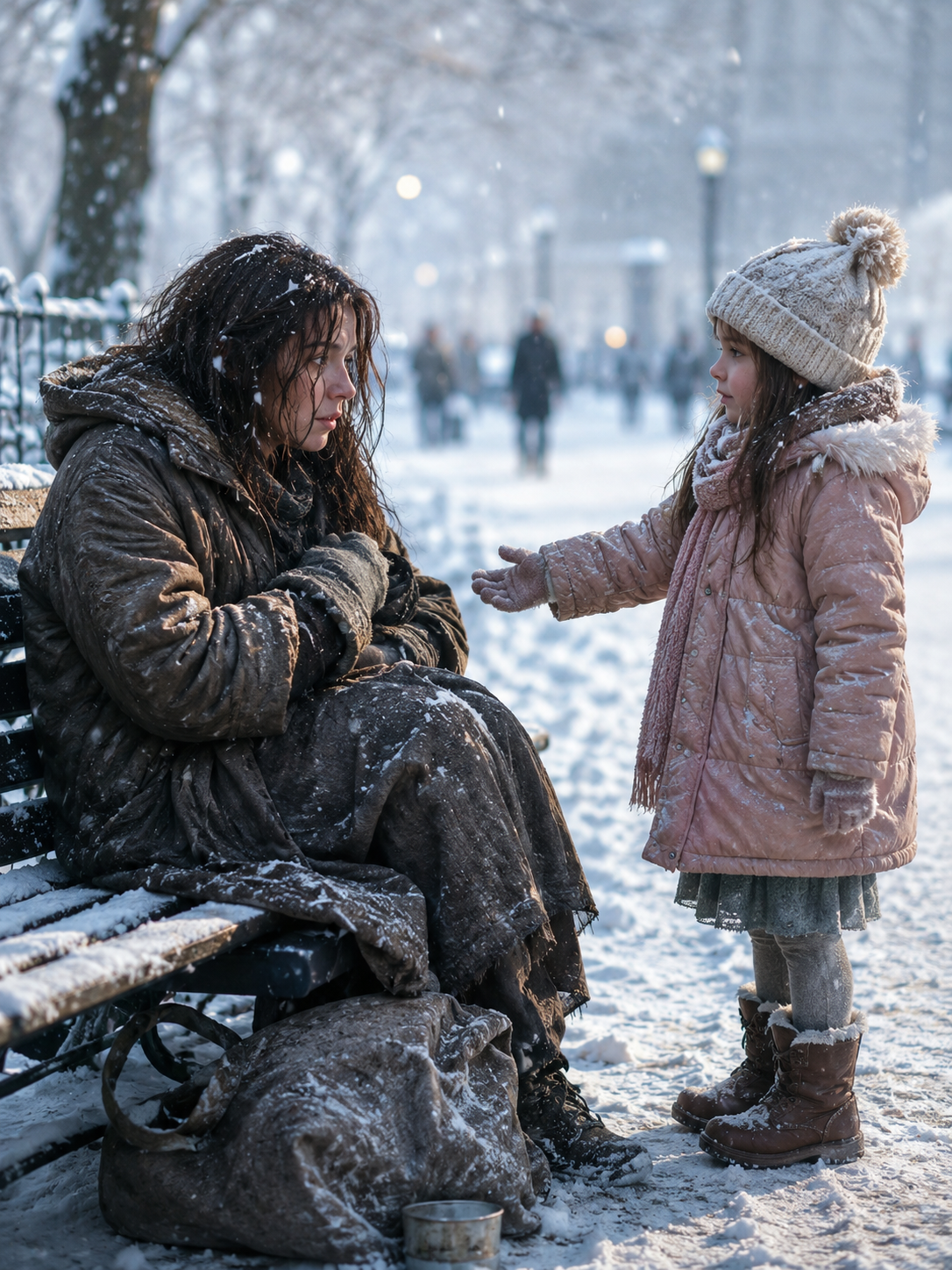
The woman sitting alone on the narrow park bench near the end of Mercer Street no longer noticed the snow piling onto her shoulders. She had stopped brushing it away nearly an hour ago. Her body had already surrendered to the cold in small ways—first her fingers, then her feet, then the aching stiffness spreading slowly through her back and chest.
Her name was Elara Vance.
At least, it used to be.
Months earlier, people had still said it with warmth. Friends. Neighbors. Someone who once kissed her forehead in the kitchen while coffee brewed in the background. Someone who once promised she would never face the world alone.
But time had a cruel way of stripping names from people.
Especially people who disappeared quietly.
Now most strangers saw only another homeless woman sitting in the snow with worn clothes, trembling hands, and exhaustion carved into every line of her face. No one looked long enough to wonder who she had been before life unraveled around her.
Elara kept her shoulders hunched tightly inward, as if folding herself smaller might somehow protect her from the wind slicing through the torn fabric of her coat. Her shoes had fallen apart weeks ago. Pieces of cardboard inside them did almost nothing against the frozen pavement beneath her feet.
Still, she stayed there.
Because sometimes having nowhere to go becomes easier than searching for places that no longer want you.
People passed constantly without slowing down. Some avoided looking at her entirely. Others glanced for only a second before pretending they hadn’t seen her.
Elara had learned not to blame them.
It hurt less that way.
She stared at the snow gathering near the curb, trying not to think about food, warmth, or memories. Memories were the worst part. Hunger faded after enough time. Cold became familiar.
But memories stayed alive.
And some nights they became unbearable.
She didn’t notice the footsteps at first.
Why would she?
Most footsteps kept moving.
But these stopped directly in front of her.
Elara slowly lifted her head.
A little girl stood there, no older than seven or eight, wrapped in a bright mustard-yellow coat that looked almost too cheerful against the storm. Snowflakes clung to strands of dark hair peeking out beneath her knitted hat. Her cheeks were pink from the cold, but her eyes were focused entirely on Elara.
Not with fear.
Not with pity.
Just attention.
Behind the girl stood a tall man in a dark wool coat, his hands tucked quietly into his pockets. He stayed several steps back, watching carefully without interfering.
The little girl tilted her head slightly.
“Are you cold?”
The question was simple.
But something about hearing genuine concern again after so long made Elara’s throat tighten unexpectedly.
For a second, she almost ignored her.
Experience had taught her that kindness rarely stayed. Sometimes it arrived only to satisfy guilt. Sometimes it disappeared the moment things became uncomfortable. Sometimes it came with invisible strings attached.
And Elara had nothing left to give anyone.
Still, the child kept waiting patiently.
“A little,” Elara answered softly at last, though the truth was far worse. “But I’m okay.”
It was the same lie exhausted adults always told children.
I’m fine.
I’m okay.
Don’t worry about me.
The girl studied her face carefully, as though she already understood that adults often hid the truth behind tired smiles and quiet voices.
Then, without another word, she extended a small brown paper bag toward her.
The top had been folded neatly. Warmth still radiated faintly through the paper.
“This is for you,” the girl said firmly. “My dad bought them for me, but you need them more.”
Elara stared at the bag.
The smell reached her first—fresh bread, something warm, maybe soup inside a sealed container. Real food. Hot food.
Her stomach twisted painfully.
For one humiliating second, she nearly cried.
Not because of the food itself.
Because someone had thought she mattered enough to give it.
Her fingers hovered uncertainly in the air. Accepting help should not have felt so difficult, yet something deep inside her resisted automatically. Pride didn’t disappear easily, even after life destroyed everything else.
“You should keep it,” Elara murmured weakly. “It’s freezing out here.”
“I know,” the little girl replied. “That’s why you need it.”
The answer was so innocent. So direct.
No judgment.
No hesitation.
No performance.